Monday, May 28, 2012

Maori Party celebrates Samoan Language Week


The Maori Party has today added their voice to the celebration of Samoan Language Week which features the theme of O le Vafealoa'i (Strong and Respectful Relationships).
"Tangata whenua share with Samoan people the value we place on our mother tongue as a key to our cultural identity' said Tariana Turia, Co-leader of the Maori Party.
"We know that our language shines a light on who we are - our relationships with our land, our waters, our geography, our genealogy, our past and our present. Indigenous language is an essential marker of our histories and our aspirations.
"We recognise the unique place that the Samoan language plays in the lives of Samoan people - protecting, representing and preserving their customs and practices for the grandchildren to inherit.
"The theme, O le Vafealoa'I also recognises the special relationship that Maori share with Samoan people, as peoples of Te Moana Nui a Kiwa".
"Strong and respectful relationships between peoples of the Pacific are also built on the basis of understanding a shared value of customs and traditions passed down from successive generations and immortalised in indigenous language".
"We also take this moment to celebrate the 50th anniversary of Samoa Independence, and acknowledge our ongoing relationship with Samoa through the signing of the Treaty of Friendship".
"The Maori Party is proud to celebrate the Samoan language and culture and to do what we can to support the teaching and learning of Samoan language as one of the most thriving languages currently existing in Aotearoa".

Ukraine in Uproar Over Status of Russian Language


Reuters
KIEV — Ukraine's ruling party has triggered violent protests with a move to upgrade the official role of Russian, a sensitive issue opponents say will split the country.
A bill by President Viktor Yanukovych's Party of Regions rekindled an emotional debate.
Russian is the mother tongue of most people in the east and south, while Ukrainian, the state language, predominates in parts of the center and in the west.
Fists flew among deputies in parliament Thursday, and a crowd of about 150 people rallied Friday outside the parliament building, many of them bearing slogans in defense of Ukrainian.
"Nobody is threatening the Russian language. It is Ukrainian that has to be saved," said Yarema Goyan, a writer, who was one of those protesting. "This is no joke. Yesterday there were fights in the parliament, but tomorrow there will be fights on the streets."
Opponents of the move regard use of Ukrainian as a touchstone of sovereignty and say a growing encroachment of Russian will only keep Ukraine in Russia's sphere of influence.
The issue sets the Party of Regions, many of whose deputies have a power base in densely populated Russian-speaking industrial areas of the east, at odds with mainstream opposition parties such as that of jailed former Prime Minister Yulia Tymoshenko.
Tymoshenko's Batkivshchyna party said the bill was a cynical move by the Party of Regions to win back disenchanted voters in time for parliamentary elections in October
It warned that the bill would lead to Ukrainian being eclipsed as a language in key areas and divide the country in two.
Tymoshenko, in a statement Friday, described it as "a crime against Ukraine, the nation, its history and the people."
Party of Regions deputies said the bill reflected reality in their constituencies, where the predominant Russian-speakers object to their children learning basic school subjects in Ukrainian and believe career paths are blocked by a lack of good Ukrainian.
"The Party of Regions during its election campaign declared that it would include in its program the need to solve the language problem in our state," said faction leader Oleksander Yefremov. "Our electorate is putting pressure on us."
The bill would significantly reinforce the domination of Russian in key regions such as the Donbass mining area near the border with Russia, the southeast and Crimea.
It would accord Russian the status of a "regional" language, allowing people living in Russian-speaking areas to insist that their children receive all their basic schooling in Russian.
People in those areas aspiring to, say, a career in regional administration would no longer have to demonstrate a strong command of Ukrainian, according to the bill.
Opponents say that in those areas where Russian is the main everyday language this would lead to Ukrainian eventually disappearing from use.
The bill will be welcomed in Moscow, where authorities complain that language rights of Russian-speakers in Ukraine are being violated.
Russian officials have pressed Yanukovych to deliver on an election promise to recognize Russian as a state language.
During parliamentary debate Thursday, opposition lawmakers prevented Party of Regions supporters of the bill from reaching the podium.
Their actions made it impossible to vote on the measure, so Party of Regions deputies retired to consider their next move.
Yanukovych, whose mother tongue is Russian, promised to make Russian the second state language during his campaign in 2009.
But he did not press the issue after coming to power in February 2010, leaving him open to reproach by Moscow.

Source: 
http://www.themoscowtimes.com/news/article/ukraine-in-uproar-over-status-of-russian-language/459335.html

Attempts to revive language spoken in Jesus' time

By Diaa Hadid
Associated Press / May 28, 2012


In a Wednesday, May 2, 2012 photo, schoolgirls study Aramaic in the Arab village of Jish, northern Israel. Jish is one of two villages in the Holy Land's tiny Christian community that are teaching Aramaic to their children in an ambitious effort to preserve the language that Jesus spoke, centuries after it all but disappeared from the modern Middle East. 
JISH, Israel—Two villages in the Holy Land's tiny Christian community are teaching Aramaic in an ambitious effort to revive the language that Jesus spoke, centuries after it all but disappeared from the Middle East.
The new focus on the region's dominant language 2,000 years ago comes with a little help from modern technology: an Aramaic-speaking television channel from Sweden, of all places, where a vibrant immigrant community has kept the ancient tongue alive.
In the Palestinian village of Beit Jala, an older generation of Aramaic speakers is trying to share the language with their grandchildren. Beit Jala lies next to Bethlehem, where the New Testament says Jesus was born.
And in the Arab-Israeli village of Jish, nestled in the Galilean hills where Jesus lived and preached, elementary school children are now being instructed in Aramaic. The children belong mostly to the Maronite Christian community. Iaronites still chant their liturgy in Aramaic but few understand the prayers.
"We want to speak the language that Jesus spoke," said Carla Hadad, a 10-year-old Jish girl who frequently waved her arms to answer questions in Aramaic from school teacher Mona Issa during a recent lesson.
"We used to speak it a long time ago," she added, referring to her ancestors.
During the lesson, a dozen children lisped out a Christian prayer in Aramaic. They learned the words for "elephant," "how are you?" and "mountain." Some children carefully drew sharp-angled Aramaic letters. Others fiddled with their pencil cases, which sported images of popular soccer teams.
The dialect taught in Jish and Beit Jala is "Syriac," which was spoken by their Christian forefathers and resembles the Galilean dialect that Jesus would have used, according to Steven Fassberg, an Aramaic expert at the Hebrew University in Jerusalem.
"They probably would have understood each other," Fassberg said.
In Jish, about 80 children in grades one through five study Aramaic as a voluntary subject for two hours a week. Israel's education ministry provided funds to add classes until the eighth grade, said principal Reem Khatieb-Zuabi.
Several Jish residenps lobbied for Aramaic studies several years ago, said Khatieb-Zuabi, but the idea faced resistance: Jish's Muslims worried it was a covert attempt to entice their children to Christianity. Some Christians objected, saying the emphasis on their ancestral language was being used to strip them of their Arab identity. The issue is sensitive to many Arab Muslims and Christians in Israel, who prefer to be identified by their ethnicity, not their faith.
Ultimately, Khatieb-Zuabi, a secular Muslim from an outside village, overruled them.
"This is our collective heritage and culture. We should celebrate and study it," the principal said. And so the Jish Elementary School become the only Israeli public school teaching Aramaic, according to the education ministry.


Their efforts are mirrored in Beit Jala's Mar Afram school run by the Syrian Orthodox church and located just a few miles (kilometers) from Bethlehem's Manger Square.
There, priests have taught the language to their 320 students for the past five years.
Some 360 families in the area descend from Aramaic-speaking refugees who in the 1920s fled the Tur Abdin region of what is now Turkey.
Priest Butros Nimeh said elders still speak the language but that it vanished among younger generations. Nimeh said they hoped teaching the language would help the children appreciate their roots.
Although both the Syrian Orthodox and Maronite church worship in Aramaic, they are distinctly different sects.
The Maronites are the dominant Christian church in neighboring Lebanon but make up only a few thousand of the Holy Land's 210,000 Christians. Likewise, Syrian Orthodox Christians number no more than 2,000 in the Holy Land, said Nimeh. Overall, some 150,000 Christians live in Israel and another 60,000 live in the West Bank.
Both schools found inspiration and assistance in an unlikely place: Sweden. There, Aramaic-speaking communities who descended from the Middle East have sought to keep their language alive.
They publish a newspaper, "Bahro Suryoyo," pamphlets and children's books, including "The Little Prince," and maintain a satellite television station, "Soryoyosat," said Arzu Alan, chairwoman of the Syriac Aramaic Federation of Sweden.
There's also an Aramaic soccer team, "Syrianska FC" in the Swedish top division from the town of Sodertalje. Officials estimate the Aramaic-speaking population at anywhere from 30,000 to 80,000 people.
For many Maronites and Syrian Orthodox Christians in the Holy Land, the television station, in particular, was the first time they heard the language outside church in decades. Hearing it in a modern context inspired them to try revive the language among their communities.
"When you hear (the language), you can speak it," said Issa, the teacher.
Aramaic dialects were the region's vernacular from 2,500 years ago until the sixth century, when Arabic, the language of conquering Muslims from the Arabian Peninsula, became dominant, according to Fassberg.
Linguistic islands survived: Maronites clung to Aramaic liturgy and so did the Syrian Orthodox church. Kurdish Jews on the river island of Zakho spoke an Aramaic dialect called "Targum" until fleeijg to Israel in the 1950s. Three Christian villages in Syria still speak an Aramaic dialect, Fassberg said.
With few opportunities to practice the ancient tongue, teachers in Jish have tempered expectations. They hope they can at least revive an understanding of the language.
The steep challenges are seen in the Jish school, where the fourth-grade Aramaic class has just a dozen students. The number used to be twice that until they introduced an art class during the same time slot -- and lost half their students.


Source: http://www.boston.com/news/world/middleeast/articles/2012/05/28/attempts_to_revive_language_spoken_in_jesus_time/

Wednesday, October 14, 2009

Learn how to pronounce English


This post is for some of my students. I wish I were as patient as this teacher! And that you were as determined as this student :p

Now repeat after me:

I.


WOULD.

like.

to buy.

a hamburguer.


GREAT!!! I knew you could do it!

Monday, December 22, 2008

Indonesian Anda


Indonesian is a young language. And some time ago I was commenting about pronouns. The use of anda in Indonesian is very interesting. I found this and thought of posting it.

There are many words for 'you' in Indonesia. Anda is the one that most closely resembles the all-purpose English pronoun 'you'. But Anda is by no means the most commonly used word for ' you' although its popularity is definitely on the rise. It is important to remember that, unlike the English 'you', Anda still cannot be used indiscriminately to all and sundry. In addition to Anda, learners of Indonesian should set out to master the appropriate use of, at the very least, Bapak, Ibu Saudara, Adik, Abang, kamu dan kalian. There is some confusion over the spelling of Anda. It would seem that for some people Anda is analogous to Bapak, Ibu, Saudara, etc and should be written with an initial capital letter. Others see it as analogous to kamu and kalian and therefore most appropriately spelled with a small initial letter. The official dictionary of standard Indonesian, the Kamus Besar Bahasa Indonesia prepared by the Government's Language Centre (Pusat Pembinaan dan Pengembangan Bahasa), spells Anda with a capital A. but it is also very common to see anda written wholly in lower case.

Anda is a fairly recent invention. Reputedly it was coined in the 1950s by Sutan Takdir Alisjahbana (1908 - 1994), the greatest of the pioneer developers of Indonesia's national language. A critic of hat he regarded as 'feudal' features of Indonesia's languages, Takdir sought to create an egalitarian second-person pronoun that could be used to address anyone, irrespective of rank and age, and that would eventually displace the hierarchy of pronouns like Tuan, NyonyaBapak, Ibu, Saudara, Adik, Abang, engkau, kamu, kaliat, etc. He detached the suffix -anda that was traditionally used to add a dimension of respect to common kinship terms (producing titles like Ayahanda, Ibunda, Ananda, Kakanda, Adinda, and others). Standing on its own, Anda was at first used almost exclusively as a catch-all second-person pronoun in advertisements and formal public announcements. Since the 1980s Anda has come to be used more and more in conversation, though it still sounds somewhat stiff. Despite its increasing use, it has so far failed to achieve "monopoly" status as a second-person pronoun. In effect, it constitutes just one more pronoun option, beside all the others, that has to be considered by speakers when choosing which second-person pronoun is the most appropriate in a particular situation.

It was taken from a Yahoo Groups and it said the source is the Indonesian learner's dictionary.

Friday, October 10, 2008

Le français langue officielle européenne

Yes, there is also a French version of the "ortography reform" story. Here it is:
Bruxelles, 8 déc. (AFP) - La Commission Européenne a finalement tranché,après la monnaie unique, l'Union Européenne va se doter d'une langue unique, à savoir... le français.Trois langues étaient en compétition : le français (parlé dans le plus grand nombre de pays de l'Union), l'allemand (parlé par le plus grand nombre d'habitants de l'Union) et l'anglais (langue internationale par
excellence).
L'anglais a vite été éliminé, pour deux raisons : l'anglais aurait été le cheval de Troie économique des Etats-Unis et les Britanniques ont vu leur influence limitée au profit du couple franco-allemand à cause de leur réticence légendaire à s'impliquer dans la construction européenne. Le choix a fait l'objet d'un compromis, les Allemands ayant obtenu que l'orthographe du français, particulièrement délicate à maîtriser soit réformée, dans le cadre d'un plan de cinq ans, afin d'aboutir à l'eurofrançais.

  1. La première année, les sons actuellement distribués entre 's', 'z', 'c', 'k' et 'q' seront répartis entre 'z' et 'k', ze ki permettra de zupprimer beaukoup de la konfuzion aktuelle.
  2. La deuzième année, on remplazera le 'ph' par 'f', ze ki aura pour effet de rakourzir un mot komme 'fotograf' de kelke vingt pour zent.
  3. La troizième année, des modifikazions plus draztikes seront pozzibles, notamment ne plus redoubler les lettres ki l'étaient; touz ont auzi admis le prinzip de la zuprezion des 'e' muets, zourz éternel de konfuzion, en efet, tou kom d'autr letr muet.
  4. La katrièm ané, les gens zeront devenu rézeptif à dé changements majeurs, tel ke remplazé 'g', zoi par 'ch', - avek le 'j' - zoi par 'k', zelon les ka, ze ki zimplifira davantach l'ékritur de touz.
  5. Duran la zinkièm ané, le 'b' zera remplazé par le 'p' et le 'v' zera lui auzi apandoné - au profi du 'f', éfidamen - on kagnera ainzi pluzieur touch zur no klafié.Un foi ze plan de zink an achefé, l'ortograf zera defenu lochik, et lé chen pouron ze komprendr et komuniké.

LE REF DE L'UNITE KULTUREL DE L'EUROP ZERA DEFENU REALITE !

Any doubts about it? :p

Tuesday, September 23, 2008

Reformas ortográficas


This is like the dream of some people I know. But let me say it now: I think they suck big time.
Anyway, this is another funny thing:

La Real Academia de la Lengua dará a conocer próximamente la reforma modelo 2000 de la ortografía española que tiene como objetivo unificar el español como lengua universal de los hispanoparlantes. Me han mandado, con carácter exclusivo, un documento reservado que revela cómo se llevará a cabo dicha reforma. Será, pues, una enmienda paulatina, que entrará en vigor poco a poco, para evitar confusiones.

La reforma hará mucho más simple el castellano de todos los días, pondrá fin a los problemas de ortografía que tienden trampas a futbolistas, abogados y arquitectos de otros países, especialmente los iberoamericanos, y hará que nos entendamos de manera universal quienes hablamos esta noble lengua.

De acuerdo con el expediente secreto, la reforma se introducirá en las siguientes etapas anuales:

Supresión de las diferencias entre "c", "q" y "k". Komo despegue del plan, todo sonido parecido al de la k (este fonema tiene su definición téknika lingüístika, pero konfundiría mucho si la mencionamos akí) será asumido por esta letra. En adelante, pues, se eskribirá kasa, keso, Kijote.

También se simplifikará el sonido de la "c" y la "z" para igualarnos a nuestros hermanos hispanoamericanos que convierten todas estas letras en un úniko fonema "s". Kon lo kual sobrarán la c y la z: "el sapato de Sesilia es asul".

Por otro lado, desapareserá la doble c y será reemplasada por x: "Tuve un axidente en la Avenida Oxidental". Grasias a esta modifikasión los españoles no tendrán ventajas ortográfikas frente a otros pueblos hispanoparlantes por su estraña pronunsiasión de siertas letras.

Así mismo, se funde la "b" kon la "v", ya ke no existe en español diferensia alguna entre el sonido de la b larga y la v chikita. Por lo kual, a partir del segundo año, desapareserá la v y beremos kómo bastará kon la b para ke bibamos felises y kontentos.

Pasa lo mismo kon la elle y la ye. Todo se eskribirá con y: "Yébeme de paseo a Sebiya, señor Biyar". Esta integrasión probokará agradesimiento general de kienes hablan kasteyano, desde Balensia hasta Bolibia. Toda b será de baka, toda b será de burro.

La hache, kuya presensia es fantasma en nuestra lengua, kedará suprimida por kompleto: así, ablaremos de abichuelas o alkool.

A partir del tercer año de esta implantación, y para mayor konsistensia, todo sonido de erre se eskribirá con doble "r": "Rroberto me rregaló una rradio".

No tendremos ke pensar kómo se eskribe sanaoria, y se akabarán esas complikadas y umiyantes distinsiones entre "echo" y "hecho". Ya no abrá ke desperdisiar más oras de estudio en semejante kuestión ke nos tenía artos.

Para ebitar otros problemas ortográfikos se fusionan la "g" y la "j", para que así jitano se eskriba komo jirafa y geranio komo jefe. Aora todo ba con jota: "El jeneral jestionó la jerensia". No ay duda de ke esta sensiya modifikasión ará que ablemos y eskribamos todos con más rregularidad y más rrápido rritmo.

Orrible kalamidad del kasteyano, en jeneral, son las tildes o asentos. Esta sancadiya kotidiana jenerara una axion desisiba en la rreforma; aremos komo el ingles, ke a triunfado unibersalmente sin tildes. Kedaran eyas kanseladas desde el kuarto año, y abran de ser el sentido komun y la intelijensia kayejera los ke digan a ke se rrefiere kada bocablo.
Berbigrasia: "Komo komo komo komo!"

Las konsonantes "st", "ps" o "pt" juntas kedaran komo simples t o s, kon el fin de aprosimarnos lo masimo posible a la pronunsiasion iberoamerikana. Kon el kambio anterior diremos ke etas propuetas osionales etan detinadas a mejorar ete etado konfuso de la lengua.

Tambien seran proibidas siertas konsonantes finales ke inkomodan y poko ayudan al siudadano. Asi, se dira: "Ke ora es en tu relo?", "As un ueko en la pare" y "La mita de los aorros son de Aguti". Entre eyas, se suprimiran las eses de los plurales, de manera que diremos "la mujere" o "lo ombre".

Despues yegara la eliminasion de la "d" del partisipio pasao y kanselasion de lo artikulo. El uso a impueto ke no se diga ya "bailado" sino "bailao", "erbido" sino "erbio" y "benido" sino "benio". Kabibajo asetaremo eta kotumbre bulgar, ya ke el pueblo yano manda, al fin y al kabo. Dede el kinto año kedaran suprimia esa de interbokalika ke la jente no pronunsia. Adema, y konsiderando ke el latin no tenia artikulo y nosotro no debemo imbentar kosa ke nuetro padre latin rrechasaba, kateyano karesera de artikulo. Sera poko enrredao en prinsipio, y
ablaremo komo fubolita yugolabo, pero depue todo etranjero beran ke tarea de aprender nuebo idioma rresultan ma fasile. Profesore terminaran benerando akademiko ke an desidio aser rreformas klabes para ke sere umano ke bibimo en nasione ispanoablante gosemo berdaderamente del idioma de Serbante y Kebedo.

Eso si: nunka asetaremo ke potensia etranjera token kabeyo de letra eñe.

Eñe rrepresenta balore ma elebado de tradision ispanika y primero kaeremo mueto ante ke asetar bejasione a simbolo ke a sio korason bibifikante de istoria kastisa epañola unibersa.
Gosh! I'd have to relearn Spanish if this were true!! :p

Friday, September 19, 2008

Semantic priming


I was reading about the Keki language (which is material for a future post) and I stummbled upon the term semantic priming. The clearest explanation I've been able to find so far is this one, in a reseach by Hutchison and Balota:


Human languages are thoroughly contextual in nature. This fact can be seen plainly by considering how the meaning of a sound, word, sentence, or passage can change drastically when taken out of context, or placed in a different context. The contextual nature of language has proven to be a major challenge for developing computer algorithms that can understand or produce language, yet humans process language in context so easily that we are usually not even aware of it. Linguistic and cognitive scientists have been studying how humans process context for decades, often with respect to individual words in the context of other words. For instance, it is well established that a person's ability to recognize a word like "dog" is enhanced when it appears shortly after a word like "cat" that is related in meaning. Results like these are referred to as "semantic priming",

Priming refers to activating parts of particular representations or associations in memory just before carrying out an action or task. The remembered item is remembered best in the form in which it was originally encountered (auditory, visual, etc.).

The hypotesis of lexical priming (found in Prof. Michael Hoey's book Lexical priming, Routledge, 2005) are:

  1. Every word is primed to occur with particular other words; these are its collocates.

  2. Every word is primed to occur with particular semantic sets; these are its semantic associations.

  3. Every word is primed to occur in association with particular pragmatic functions; these are its pragmatic associations.

  4. Every word is primed to occur in (or avoid) certain grammatical positions, and to occur in (or avoid) certain grammatical functions; these are its colligations.

  5. Co-hyponyms and synonyms differ with respect to their collocations, semantic associations and colligations.

  6. When a word is polysemous, the collocations, semantic associations and colligations of one sense of the word differ from those of its other senses.

  7. Every word is primed for use in one or more grammatical roles; these are its grammatical categories.

  8. Every word is primed to participate in, or avoid, particular types of cohesive relation in a discourse; these are its textual collocations.

  9. Every word is primed to occur in particular semantic relations in the discourse; these are its textual semantic associations.

  10. Every word is primed to occur in, or avoid, certain positions within the discourse; these are its textual colligations.

Thursday, September 18, 2008

Ongoing action reseach project

First of all, thanks for volunteering. I am doing this because I need some data about student's vocabulary for my action research project (check here if you want to know more about action research).
For those who will dare to be part of this project, the first step is to answer this vocabulary test (which is version A).
Onece you finish each level, press the "check" button and your result will appear on the left-hand side of the screen. Please write down your results for each level and send it to my e-mail address (which I should have given you after the class).
After you finish a level (and see your result), you can go to the next level by pressing the button "Next level".
If you have any doubts about this, please let me know. You can leave a comment in this post or send it directly to my inbox.

Again, all information I gather from this is absolutely confidential and will not have any impact on your grades.

Thanks for helping!

-Javier

Tuesday, September 16, 2008

Cambridge exams in English language


More than 2 million people in 130 countries take one of the many Cambridge exams. The most popular ones are the First Certificate in English (FCE) and the Certificate of Proficency in English (CAE).
I've seen peopleo who are not sure about what exam would be right for them. For some days, Cambridge ESOL has been piloting an online test at their website so candidates can know which exam is best for them. It consists of only 20 multiple-choice questions. You can try it out here.
Next year I might be taking one of those (if I have the money, that is).

It'd be great if you'd like to share here what test you were reccommended to sit.

Saturday, September 6, 2008

Just because

Yes, that's exactly why. And because it had to be today. Javier, enjoy.

Tuesday, September 2, 2008

¿Culturas nacionales?

I'd like to quote something I read today. I found it very interesting.

Sabemos que todos los estados nacionales fueron creaciones artificiales en algún momento de la historia y que, en la mayoría de los casos, las nuevas fronteras agruparon a pueblos diferentes, los cuales muchas veces ni siquiera compartían un idioma común (un buen ejemplo al respecto es México). Para llegar a definirse como integrantes de una sola nación, los ciudadanos tuvieron que sufrir un largo proceso de ideologización política y de aprendizaje de la lengua dominante, procesos que hasta la fecha en muchos estados nacionales no han quedado totalmente concluidos. ¿Por qué entonces suponer una cultura nacional, si estas naciones fueron integradas por grupos distintos, cada uno con su propia historia cultural?


[Taken from Lenguas en contexto, from 2005]

Something I hadn't thought of!
I'll keep on reading this article (yeah, yeah. It is homework. I have to anyways!)

Monday, September 1, 2008

Tips for writing

The text in previous post made me remember this set of tips. I read it at PB, posted by Marta.

1. Verbs has to agree with their subjects.
2. Prepositions are not words to end sentences with.
3. And don't start a sentence with a conjunction.
4. It is wrong to ever split an infinitive.
5. Avoid clichés like the plague. (They're old hat)
6. Also, always avoid awkward, affected, annoying alliteration.
7. Be more or less specific.
8. Parenthetical remarks (however relevant) are (usually) unnecessary.
9. Also too, never, ever use repetitive redundancies.
10. No sentence fragments.
11. Contractions aren't necessary and shouldn't be used.
12. Foreign words and phrases are not apropos.
13. Do not be redundant; do not use more words than necessary; it's highly superfluous.
14. One should never generalize.
15. Comparisons are as bad as clichés.
16. Don't use no double negatives.
17. Eschew ampersands & abbreviations, etc.
18. One-word sentences? Eliminate.
19. Analogies in writing are like feathers on a snake.
20. The passive voice is to be ignored.
21. Eliminate commas, that are, not necessary. Parenthetical words however should be enclosed in commas.
22. Never use a big word when a diminutive one would suffice.
23. Kill all exclamation points!!!
24. Use words correctly, irregardless of how others use them.
25. Understatement is always the absolute best way to put forth earth shaking ideas.
26. Use the apostrophe in it's proper place and omit it when its not needed.
27. Eliminate quotations. As Ralph Waldo Emerson said, "I hate quotations. Tell me what you know."
28. If you've heard it once, you've heard it a thousand times: Resist hyperbole; not one writer in a million can use it correctly.
29. Puns are for children, not groan readers.
30. Go around the barn at high noon to avoid colloquialisms.
31. Proofread carefully to see if you words out.
32. Do not put statements in the negative form.
33. If you reread your work, you can find on rereading a great deal of repetition can be avoided by rereading and editing.
34. A writer must not shift your point of view.
35. Place pronouns as close as possible, especially in long sentences, as of 10 or more words, to their antecedents.
36. Writing carefully, dangling participles must be avoided.
37. If any word is improper at the end of a sentence, a linking verb is.
38. Take the bull by the hand and avoid mixing metaphors.
39. Avoid trendy locutions that sound flaky.
40. Everyone should be careful to use a singular pronoun with singular nouns in their writing.
41. Always pick on the correct idiom.
42. The adverb always follows the verb.
43. Avoid run-on sentences they are hard to read.
44. Use the semicolon properly, always use it where it is appropriate; and never where it isn't.
45. Hyphenate between sy-llables and avoid un-necessary hyphens.
46. Write all adverbial forms correct.
47. It is incumbent on us to avoid archaisms.
48. Steer clear of incorrect forms of verbs that have snuck in the language.
49. Don't string too many prepositional phrases together unless you are walking through the valley of the shadow of death.
50. "Avoid overuse of 'quotation "marks."'"

Saturday, August 30, 2008

English-Asylum for the verbally insane

Today I was at a Pearson workshop and they gave us this text. I had read bits of it here and there on the internet, so now it is my tipe to post it as well.

English-Asylum for the verbally insane

We'll begin with a box and the plural is boxes.
But the plural of ox becomes oxen, not oxes.
One fowl is a goose, but two are called geese,
yet the plural of moose should never be meese.
You may find a lone mouse or a nest full of mice,
yet the plural of house is houses, not hice.

If the plural of man is always called men,
why shouldn't the plural of pan be called pen?
If I speak of my foot and show you my feet,
and I give you a boot, would a pair be called beet?
If one is a tooth and a whole set are teeth,
why shouldn't the plurall of booth be called beeth?

Then one may be that, and three would be those,
yet hat in the plural would never bee hose,
and the plural of cat is cats, not cose.
We speak of a brother and also of brethren.
But though we say mother, we never say methren.
Then the masculine pronouns are he, his and him,
but imagine the feminine: she, shis and shim!

Let's face it. English is a crazy language.
There is no egg in eggplant nor ham in hamburger;
neither apple nor pine in pineaplle.
English muffins weren't invented in England.
We take English for granted, but if we explore its paradoxes,
we find that quicsand can work slowly, boxing rings are square,
and a guinea pig is neither from Guinea nor is a pig.
And why is that writers write but fingers don't fing,
grocers don't groce and hammers don't ham?

If teacher taught, why didn't preachers praught?
If a vegetarian eats vegetables, what does a humanitarian eat?
Sometimes I think all the folks who grew up speaking English
should be committed to an asylum for the verbally insane.

In what other language do peoplerecite at a play and play at a recital?
We ship by truck and send cargo by ship.
We have noses that run and feet that smell.
We park in the driveway and drive in the parkway.
And how can a slim chance and a fat chance be the same,
while a wise man and a wise guy are opposites?

You have to marvel at the unique lunacy of a language in which
your house can burn up as it burns down,
in which you fill in a form by filling it out,
and in which an alarm goes off by going on.

And, in closing, if Father Pop, how come Mother's not Mop?

Thursday, August 28, 2008

Engels leren

This is a Dutch TV commercial:


Yeah. It is kind of important to understand a little what the music you like is about!

Wednesday, August 27, 2008

Indefinite plural form of Swedish nouns


Swedish, Norwegian and Danish behave pretty much the same when it comes to grammar. The form of their nouns (definite and indenite in singular and plural) is something that can be difficult for learners.

There are five main ways of forming the plural of nouns in Swedish:
  1. en blomma (a flower) → två blummor. The majority of nouns in this declension are en-nouns ending in -a. They drop the -a before the plural ending. A few nouns of this group do not end in -a (en rose, en våg, en åder).

  2. en arm (an arm) → två armar. All nouns belonging to this declension are en-nouns (with the exception of ett fingertvå fingrar). All en-nouns ending in -dom and -ing belong to this group.

  3. en kostym (a suit) → två kostymer. Both en-nouns and ett-nouns are found in this declension. note that many nouns in this group modify their stem-vowel in the plural. Latin words ending in -eum and -ium belong to this group.

  4. ett äpple (an apple) → två äpplen. The majority of nouns in this declension are ett-nouns ending in a vowel, usually -e.

  5. ett glas (a glass) → två glas. They have no ending. To shis declension belong ett-nouns ending in a consonant and en-nouns ending in -are, -ande and -ende. note that some common nouns also modify their stem-vowel (en bro(de)rtvå bröder, en mantvå män).


According to the book Basic Swedish word list, by Martin Samuel Allwood, 12 % of the 1000 most used Swedish words belong to the first declension; 37 %, to the second; 21 %, to the third; 4 %, to the fourth; and 26 %, to the fifth.

All this would be pretty cool if I had already told the whole story.

Nouns ending in unstressed -e, -el, -en and -er drop the -e before the plural endings -or, -ar and -er:

en toffel (a slipper) → två tofflor, en poijke (a boy) → två pijkar, en dottertvå döttar (note here also the change in the stem-vowel), en regel (a rule) → två regler.

Some nouns form their plural with the ending -r only: en händelse (an event) → två händelser, en ko (a cow) → två kor.

As you can see, some nouns change the stem-vowel and some other, beside that change, also double the final consonant.

Yes, it is like Norwegian... but this is not helping!


Tuesday, August 26, 2008

More Danish language

Several months ago I posted a video from the Norwegian series Uti Vår Hage about Danish language.
There is a second part to it! These guys are really funny. Here it is:

Monday, August 25, 2008

Schemata


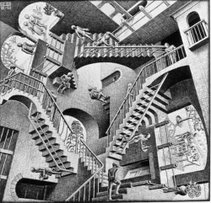
Every time we face a situation in language learning, we relay on our schemata and not only on the linguistic information we are facing. These schemata are unconscious mental structures that represent an individual's generic knowledge about the world. It is through schemata that old knowledge influences new information.
Relationships among different levels of abstraction are conceived to be like webs (rather than hierarchical); thus each one is interconnected with many others (as in the image above).
In 1977, Richard C. Anderson brought this concept into the education field. But the term was not entirely new as Piaget had already used it.
According to Anderson, some characteristics of schemata are:
  • Schemata are always organized meaningfully, can be added to, and, as an individual gains experience, develop to include more variables and more specificity.
  • Each schema is embedded in other schemata and itself contains subschema.
  • Schemata change moment by moment as information is received.
  • They may also be reorganized when incoming data reveals a need to restructure the concept.
  • The mental representations used during perception and comprehension, and which evolve as a result of these processes, combine to form a whole which is greater than the sum of its parts.
In order to better understand how schema theory fits into the reading of a foreign language, you can read this article.

Monday, April 21, 2008

Jabberwocky


Is there any nonsense that is not useless? And even nonsense that can be interesting?
You might like to take a look (again) to something Lewis Carroll wrote:

"'Twas brillig, and the slithy toves
Did gyre and gimble in the wabe;
All mimsy were the borogoves,
And the mome raths outgrabe.

'Beware the Jabberwock, my son!
The jaws that bite, the claws that catch!
Beware the Jubjub bird, and shun
The frumious Bandersnatch!

He took his vorpal sword in hand:
Long time the manxome foe he sought--
So rested he by the Tumtum tree,
And stood awhile in thought.

And as in uffish thought he stood
, The Jabberwock, with eyes of flame,
Came whiffling through the tulgey wood,
And burbled as it came!

One, two! One, two! And through and through
The vorpal blade went snicker-snack!
He left it dead, and with its head
He went galumphing back.

'And hast thou slain the Jabberwock?
Come to my arms, my beamish boy!
O frabjous day! Callooh! Callay!
' He chortled in his joy.

'Twas brillig, and the slithy toves
Did gyre and gimble in the wabe;
All mimsy were the borogoves,
And the mome raths outgrabe.


If you need help with some of those words, you might like to take a look here or here.

Tuesday, March 4, 2008

Translation of Facebook

Am I a pesimist or what? This news report (and probably most people who is informed about this) is saying that is it such a cool thing. But is it really?
How many social networks are theour out there? I have no idea. But they have grown as mushroons in rainy season. And I have no idea either of why they are so popular (I might be getting old...). Besides from the game Facebook is now featuring, I don't see much to do at those sites.

1500 volunteers translating the whole site into Spanish. Sounds great, huh? But as a native Spanish speaker, I am quite disappointed at the level of that translation.
Out of curiosity, I wanted to be part of that volunteering team. I wanted to know how that translation was being carried out.
There was a text (a sentence) to be translated. You did it as best as you could, just as others were doing. Then, volunteers voted on the accuracy of that translation. I guess the one with most vote was the one Facebook was going to keep.
So far, so good. But who are these volunteers? Are the native speakers? Are they advanced students?
I am very skeptic about democracy, and here it didn't work as well as expected. There is still need for some kind of moderation. People who think are good enough to do the translation is voting too. And from what I saw, they are majority.

Yes, it keeps me wonder how the German translation will be.

Of course, I was not into it deeply, so if anybody who actually participated in the Spanish translation or is participating in the German translation and sees things in a different way (or with what actually goes on and not from an outsider's perspective), it'd be nice to be corrected by you.